A pitch count can look like a simple number in a scorebook: 20 pitches, 50 pitches, 75 pitches. But behind that number is a much larger player-safety question: How much throwing can a young arm handle, and how much recovery does it need before pitching again?
That is the question the Pitch Smart initiative is designed to help answer.
Launched by Major League Baseball and USA Baseball in November 2014, Pitch Smart provides age-specific pitch limits, required rest recommendations and broader guidance for the health of amateur pitchers.1 2 Its purpose is not to prevent young athletes from pitching. It is to help them pitch in a way that gives their bodies time to recover and gives them a better chance to enjoy long, healthy careers in the game.
Pitch Smart did not invent the pitch count, however. It represents the modern form of a player-safety movement that had been developing for decades.
The goal is not simply to keep a pitcher eligible for the next game. It is to keep the player healthy for the next season, and the seasons after that.
Why pitch counting became necessary#
Pitching is a repeated, high-intensity motion. The stress from one properly thrown pitch is not necessarily the problem. The greater concern is accumulated stress: too many pitches in an outing, too little rest between outings, too many innings in a season or too many months of pitching without an offseason.
Young players are especially important to protect because their bones, growth plates, muscles and connective tissues are still developing. Their ability to throw hard may advance faster than their bodies’ ability to tolerate a large workload (the ‘engine’ is stronger than the ‘brakes’). A player may also continue pitching through fatigue or discomfort because they want to compete, does not want to disappoint the team or does not recognize the warning signs.
The research increasingly pointed to workload and fatigue as central risk factors. A 2006 study comparing adolescent pitchers who had shoulder or elbow surgery with healthy pitchers found that the strongest associations with serious injury involved overuse and fatigue. Pitchers who regularly continued pitching while fatigued were far more likely to be in the injured group.3 A separate 10-year prospective study found that players who exceeded 100 innings in a calendar year were 3.5 times as likely to sustain a serious injury.4
Inningly was built to track pitcher workloads
Those studies do not mean that every player who crosses a particular number will be injured, or that staying below a limit makes injury impossible. They show WHY workload deserves to be managed before pain appears. Other research has also found relationships among pitch count, pitch type, mechanics and reported elbow or shoulder pain.5 Pitch counts are a practical way to estimate repeated stress and connect the size of an outing to the recovery that should follow.
Workload should be managed before pain appears—not only after a player says their arm hurts.
Before Pitch Smart: the move from innings to pitches#
Baseball historically managed young pitchers through innings limits. That was convenient, but innings are an inconsistent measure of work. A clean inning might require eight or ten pitches. An inning filled with walks, foul balls and deep counts might require 30 or more. Both count as one inning, even though the physical workloads are very different.
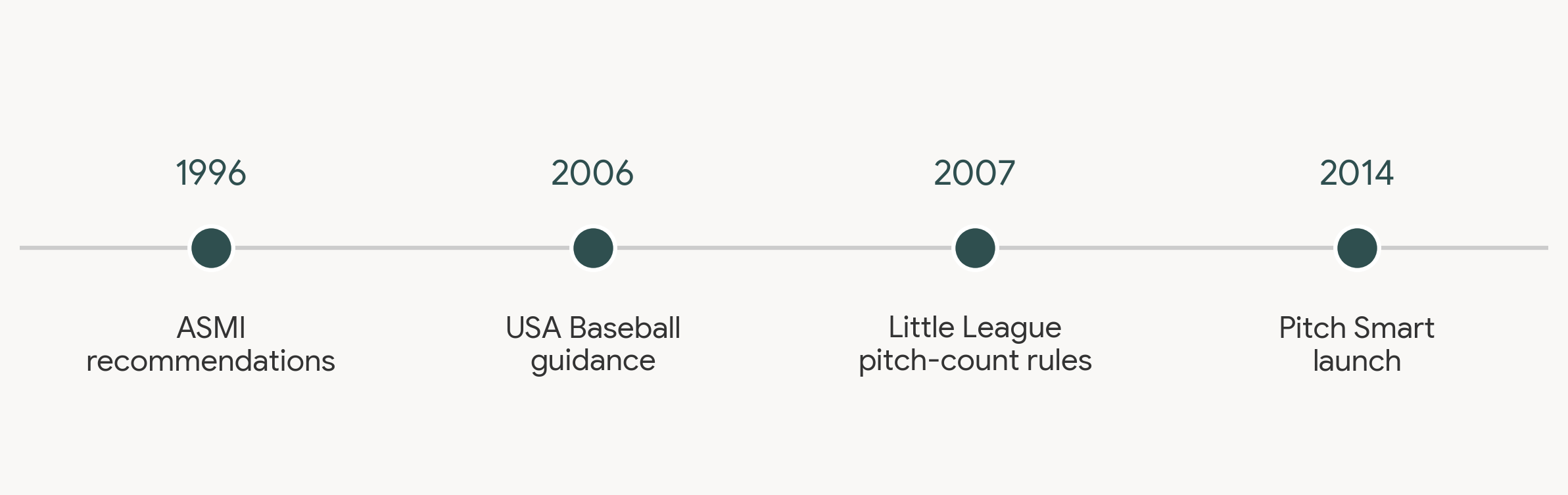
Medical experts had discussed limits for youth pitchers well before Pitch Smart. In 1996, the American Sports Medicine Institute brought together orthopedic surgeons and baseball coaches to develop age-based pitch-count recommendations. As more research became available, USA Baseball’s Medical and Safety Advisory Committee issued more detailed recommendations in 2006, including game, week, season and annual workload limits for young pitchers.6
Little League was among the first major youth organizations to turn the concept into an enforceable rule. After several years of research and a 2006 vote by its international board, Little League replaced its innings-based restriction with age-based pitch counts and required rest for the 2007 regular season and tournament play.7
That change was significant. Instead of treating every inning as equal, it tied a pitcher’s next date of eligibility to the actual number of pitches thrown.
The launch of Pitch Smart#
MLB and USA Baseball launched Pitch Smart on November 12, 2014. The organizations had spent the 2014 season bringing together recommendations from leading medical experts and baseball officials. The goal was to give the amateur baseball community a comprehensive and understandable source for safe pitching practices.2
Pitch Smart also created a common framework in a fragmented baseball environment. A young athlete might play for a local league, a travel organization, a school team, a tournament team or a showcase—all with different coaches and potentially different rules. A shared set of recommendations gave those organizations, as well as parents and athletes, a consistent reference point.
In 2015, MLB and USA Baseball added a compliance program to recognize organizations that incorporated Pitch Smart pitch-count and rest standards. Little League and Dixie Baseball were early full-compliance organizations, while other national organizations adopted or supported the standards over time.8
Pitch Smart has continued to evolve. Guidelines taking effect in 2018 adjusted recovery thresholds for older pitchers and added a rule that a pitcher should not appear on three consecutive days, regardless of how few pitches were thrown.9 In 2021, MLB and USA Baseball added a gradual, preseason throwing progression in response to the unusual workloads created by the disrupted 2020 season.10 These changes reinforce an important point: the recommendations are intended to reflect developing evidence and real pitching conditions, not remain frozen forever.
What Pitch Smart recommends today#
The most familiar part of Pitch Smart is its table of daily maximums and required rest. As of August 2026, the recommendations are shown below.1
| Age | Daily maximum | 0 days’ rest | 1 day | 2 days | 3 days | 4 days |
|---|---|---|---|---|---|---|
| 7–8 | 50 | 1–20 | 21–35 | 36–50 | — | — |
| 9–10 | 75 | 1–20 | 21–35 | 36–50 | 51–65 | 66–75 |
| 11–12 | 85 | 1–20 | 21–35 | 36–50 | 51–65 | 66–85 |
| 13–14 | 95 | 1–20 | 21–35 | 36–50 | 51–65 | 66–95 |
| 15–16 | 95 | 1–30 | 31–45 | 46–60 | 61–75 | 76–95 |
| 17–18 | 105 | 1–30 | 31–45 | 46–60 | 61–80 | 81–105 |
| 19–22 | 120 | 1–30 | 31–45 | 46–60 | 61–80 | 81–105* |
* For ages 19–22, Pitch Smart recommends five days of rest after 106–120 pitches.
The table is only one part of the guidance. Pitch Smart also recommends that young pitchers:
- take an offseason from pitching and overhead throwing;
- avoid pitching for multiple teams during overlapping seasons;
- avoid pitching in multiple games on the same day;
- monitor fatigue and stop when pain occurs;
- account for workload across leagues, tournaments and showcases;
- avoid combining heavy pitching and catching workloads;
- develop sound throwing mechanics and warm up properly; and
- play other sports rather than specialize in baseball year-round at a young age.
For players ages 9–12, Pitch Smart recommends no more than 80 combined innings in any 12-month period and at least four months away from throwing each year, including at least two to three continuous months.
For ages 13–18, the annual recommendation is no more than 100 combined innings, along with a comparable offseason from throwing or competitive pitching.1 The American Academy of Pediatrics similarly emphasizes monitoring workload, avoiding year-round specialization and responding promptly to pain or fatigue.11
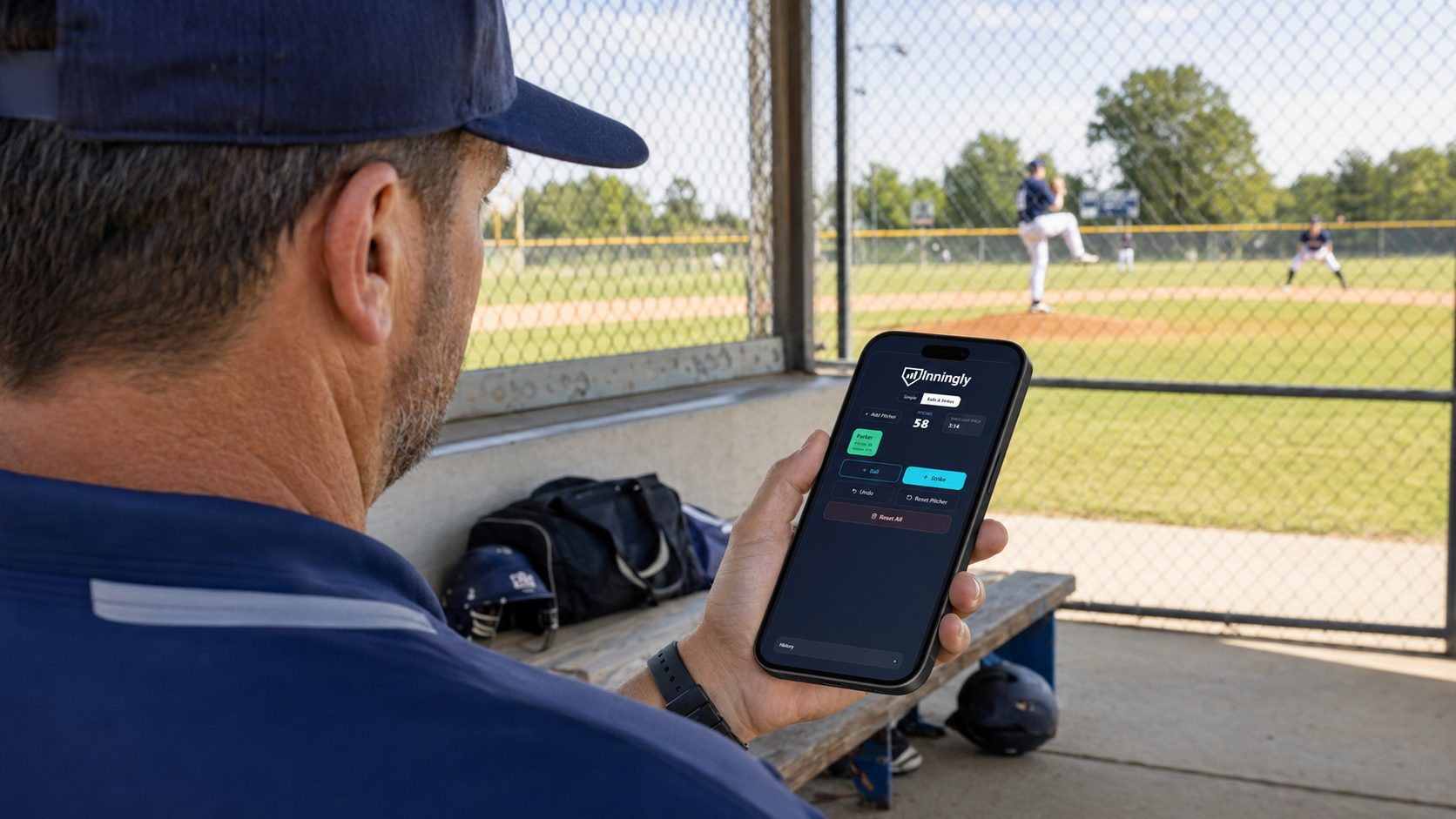
The daily maximum is a safety boundary, not a target.
Recommendations are not always the same as rules#
Pitch Smart is a national safety framework, not a single rulebook governing every baseball game. Individual organizations decide which standards to adopt and how to enforce them.
Little League has its own age-based pitch-count regulations that align closely with Pitch Smart.8 At the high-school level, the National Federation of State High School Associations changed its rule in 2016 to require each state association to establish a pitch-based restriction policy.12 That replaced the former national approach based on innings, but it also means the exact pitch limits and rest thresholds can vary by state. Travel leagues and tournament operators may use Pitch Smart, create their own limits or impose rules that are less protective.
Coaches and parents should therefore understand two different standards:
- Eligibility: What does this league’s rule allow the player to do today?
- Workload: Considering everything the player has thrown, what is the responsible choice for the player today?
A pitcher may be legally eligible under one tournament’s rules while still needing rest because of pitches thrown for another team, a recent bullpen session, a showcase or signs of fatigue. Pitch Smart explicitly says that the parent and athlete ultimately need to track the player’s workload across affiliations and across the year.1
Eligible does not always mean recovered.
A pitch count is a starting point, not the whole workload#
Game pitches are the easiest throws to count, but they are not the only throws that place stress on an arm. Warm-up pitches, bullpen sessions, between-inning throws, long toss, practice work and throws from other positions all contribute to a player’s total workload. The intensity of those throws matters, too.
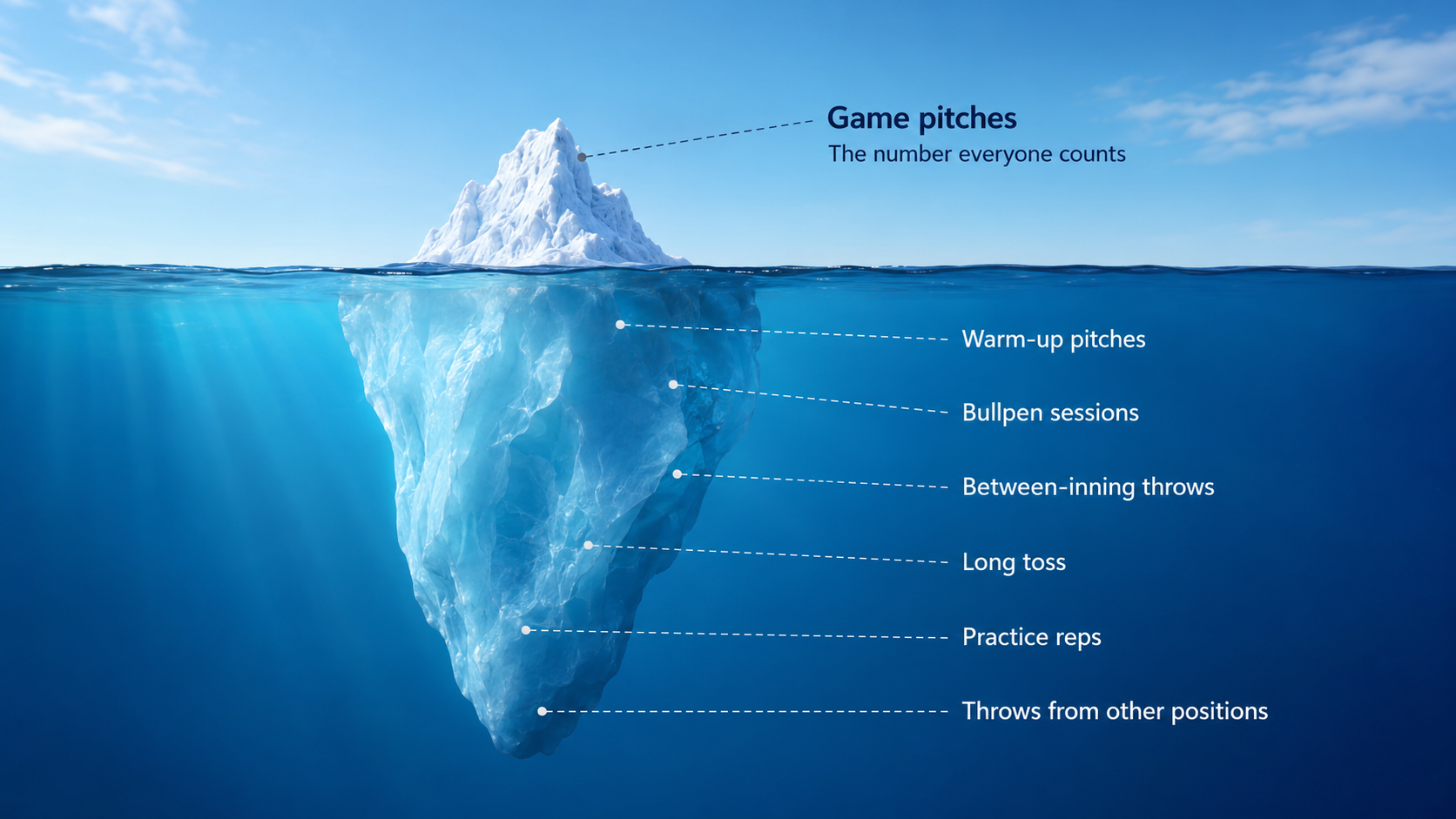
That is why a coach should never use the daily maximum as a target. A 13-year-old being allowed to throw as many as 95 pitches does not mean that 95 pitches is the right plan for every 13-year-old, every outing or every point in the season. Experience, physical maturity, recent workload, mechanics, weather, recovery and visible fatigue all matter.
The better question is not, “How many pitches can we get from them?” It is: “What workload makes sense for this player today, and what recovery will they need afterward?”
Why shared workload records matter#
Modern youth baseball often extends beyond one team and one season. That makes communication just as important as the number itself. No individual coach can responsibly manage a player’s arm without knowing what that player has done elsewhere.
Parents should tell coaches about recent pitching, private lessons, bullpens and arm discomfort. Coaches should record pitch totals accurately, communicate required rest and resist treating a tournament game as more important than a player’s long-term health. Players should be taught that reporting fatigue or pain is responsible, not selfish.
Pitch Smart gives baseball a common language for those conversations. The daily pitch count matters, but the larger idea matters more: young pitchers need appropriate limits, honest communication and real recovery time.
There will always be pressure to get one more out, finish one more inning or use the best available arm in an important game. Player safety asks adults to take the longer view. The objective is not merely to keep a pitcher available for Sunday. It is to help keep that player healthy enough to take the mound next season—and, hopefully, for many seasons after that.
How Inningly supports responsible workload management#
This is the player-safety problem Inningly is designed to help coaches manage. Pitcher workload does not begin with the first pitch of a game or end with the final out. Inningly can be used to record many kinds of pitching work, from in-game pitch totals to bullpens thrown at practice, during a lesson or at home.
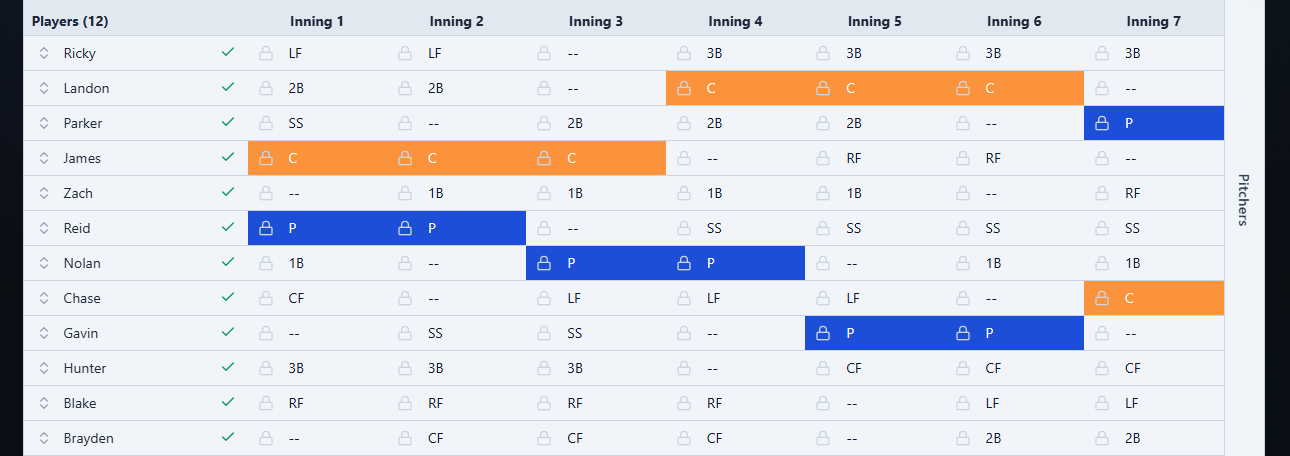
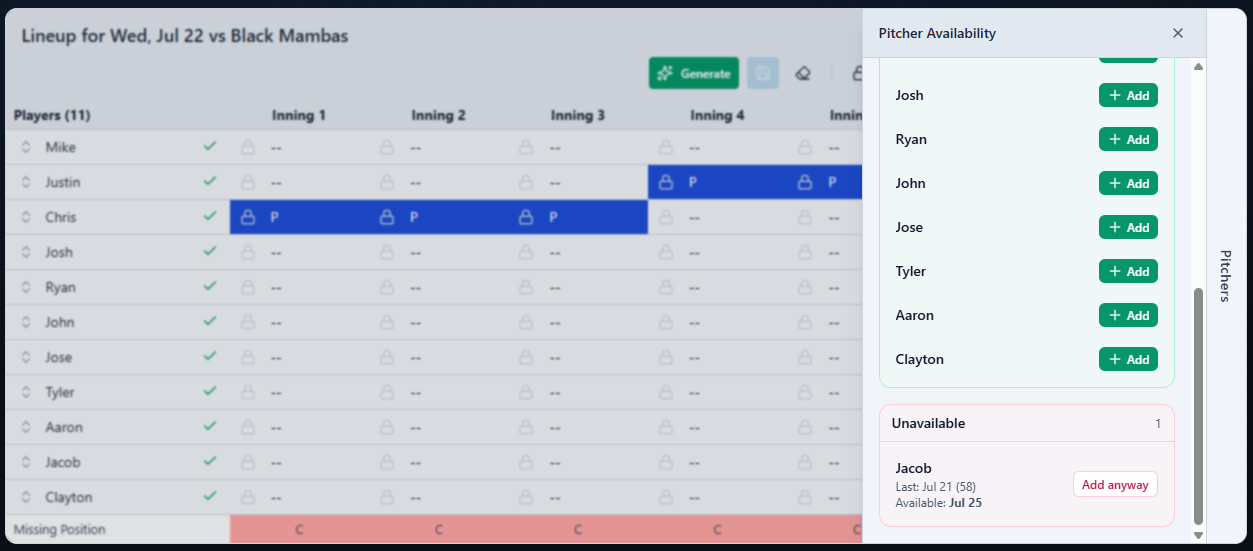
Those records are translated into at-a-glance pitcher availability using accepted age-based guidelines. When a coach begins building a lineup for a known game date, pitcher availability is immediately available alongside the roster (See: How to Use the Lineup Builder to Your Advantage). There is no need to reconstruct several days of pitching from memory or search through old scorebooks before deciding who can safely take the mound.
That convenience matters, but the larger benefit is protection. A clear workload record reduces the chance that a coach will accidentally overuse a player—especially a young athlete who may not speak up about fatigue, soreness or a desire to avoid disappointing the team.
Technology cannot replace a coach’s judgment, communication with families or attention to how a player feels. It can make the relevant information much harder to overlook at the moment a pitching decision is made.
It may seem like a small thing: putting pitcher availability next to the lineup. It isn’t. Player health is everything.
Sources and further reading#
This article provides general educational information and is not medical advice. A player with elbow or shoulder pain should stop throwing and be evaluated by an appropriate medical professional.
-
MLB and USA Baseball launch Pitch Smart (November 12, 2014) ↑↑
-
Olsen et al.: Risk factors for shoulder and elbow injuries in adolescent baseball pitchers ↑
-
Fleisig et al.: Risk of serious injury for young baseball pitchers—A 10-year prospective study ↑
-
Lyman et al.: Effect of pitch type, pitch count and mechanics on elbow and shoulder pain ↑
-
American Sports Medicine Institute: Position Statement for Adolescent Baseball Pitchers ↑
-
Little League history: adoption of pitch counts for the 2007 season ↑
-
American Academy of Pediatrics: Baseball and Softball policy statement ↑
-
NFHS: Pitching restriction policies to be based on pitches ↑